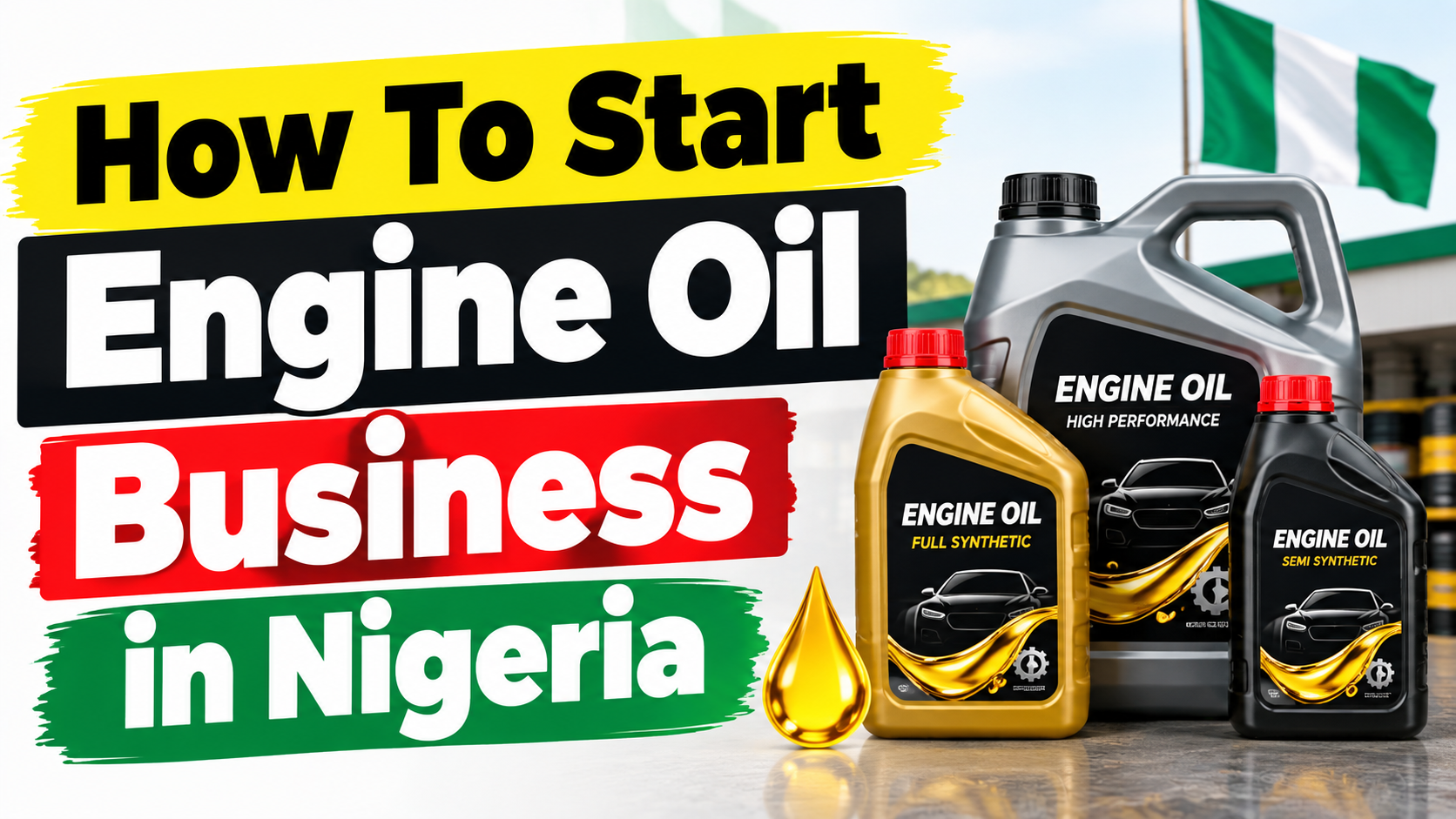
If you are looking for how to start engine oil business in Nigeria in 2026, you are looking at a business with steady demand because cars, motorcycles, generators, trucks, and other machines need engine oil regularly. The good thing is that you do not need to start with millions of naira or own a filling station before you can enter the business.
Nigeria runs on engines. Cars, keke, buses, trucks, generators, construction machines, and factory equipment all need lubricant.
🚀 Learn AI Video Creation & Start Building Digital Skills
Want to learn how to create AI videos for YouTube, TikTok, Facebook, and other platforms? Choose an option below to get started.
🎥 Start AI Video Training 📚 Watch Free AI Lessons ⭐ Join the Premium AI Program✔ Beginner Friendly | ✔ Learn at Your Own Pace | ✔ Practical AI Video Skills
This guide walks you through the market, the business models that actually work, the licences you need, realistic startup costs, where to buy stock, how to sell, and the mistakes that wipe out new dealers. It is written for first-time owners who want a clear path, not a theory lecture.
Why the Engine Oil Business Still Makes Sense in 2026
Demand does not depend on one big contract. It comes from millions of small, repeat purchases.
Industry estimates put Nigeria’s lubricant market at about 580 million litres in 2026, up from roughly 564 million litres in 2025, with volume expected to keep rising toward the early 2030s. Automotive engine oil still accounts for the largest slice of that market, around 38% of sales, because heat, dust, traffic, and older vehicles force frequent oil changes.
Three things keep the business alive:
- A large, ageing vehicle fleet. Commercial buses, taxis, and trucks use far more oil than private cars. Many engines on Nigerian roads are not new, so they need shorter drain intervals.
- The generator economy. Homes, shops, hospitals, and factories still run generators. Each unit is another oil customer.
- Industry and construction. Cement plants, steel works, farms, and road projects buy hydraulic oil, gear oil, and grease in drums, not just 4-litre bottles.
Value estimates differ by source, but several reports place the Nigerian lubricant market well above $1 billion a year, with room to grow as more vehicles come onto the road and factories expand.
You do not need a refinery to take a share of that demand. Most profitable operators start as retailers or wholesalers, then grow into distribution or blending.
Types of Engine Oil Business You Can Start
Pick a model that matches your capital, location, and experience. Mixing models too early is how people lock money in unsold stock.
1. Roadside or kiosk retail
This is the lowest-cost entry. You sell 1-litre and 4-litre packs, plus a few common grades such as 20W-50 and 15W-40, near a mechanic village, park, or busy junction.
Best for: first-time traders, people who already know local mechanics.
Typical capital: about ₦300,000 to ₦1 million.
2. Shop or mini-mart retail
A proper shop with shelves, a wider brand mix, filters, grease, brake fluid, and ATF. You serve walk-in car owners and nearby workshops.
Typical capital: about ₦1 million to ₦5 million, depending on rent and stock depth.
3. Wholesale to mechanics and small shops
You buy cartons and drums from depots or brand distributors, then supply retailers and workshops in your area. Volume is higher; margin per litre is usually lower than retail.
Typical capital: about ₦1.5 million to ₦5 million.
4. Brand dealership or distribution
You apply to become an authorised dealer for TotalEnergies, Mobil (11Plc), Castrol, Oando, Eterna, Conoil, or a strong local brand. You get branded stock, sometimes credit or marketing support, and a defined territory. Capital and warehouse standards are stricter.
Typical capital: often ₦5 million to ₦10 million or more, plus the brand’s own deposit and stock rules.
5. Own-brand blending or contract packing
You blend base oil with additives, or pay a licensed plant to pack under your label. This is manufacturing, not trading. You need NMDPRA licensing, SON MANCAP certification, a lab, and serious working capital.
Typical capital: small plants often start from tens of millions of naira; a modest 1,000-ton-per-year plant can run into ₦150 million and above once land, tanks, stock, and licences are included.
Start where you can restock quickly. Most successful blenders first learned the market as traders.
Products That Sell Fast in Nigeria
Do not stock everything on day one. Sell what workshops actually request.
Automotive engine oil
- Mineral and semi-synthetic 20W-50 for older petrol cars and many taxis
- 15W-40 diesel oil for buses, trucks, and generators
- 10W-40 and 5W-30 for newer petrol engines
- Fully synthetic 5W-40 / 0W-40 for premium cars (higher price, slower turn in some towns)
Other lubricants that complete the shop
- Gear oil (90, 85W-140)
- Automatic transmission fluid (ATF)
- Hydraulic oil (ISO 32, 46, 68)
- Grease (multipurpose and high-temperature)
- Brake fluid
- Two-stroke oil for okada and generators
- Coolant and oil filters (these raise basket size)
Pack sizes
- 1 litre and 4/5 litres for retail
- 20 litres for workshops
- 200/205-litre drums for fleets and factories
Popular names customers already trust include Total Quartz, Mobil Super / Mobil 1, Castrol GTX and Magnatec, Shell Helix (where available through Ardova channels), Oando, Eterna, Conoil, MRS, and a long list of mid-tier and local brands. Price varies by city and week, so treat any online price list as a snapshot, not a fixed rate.
Retail prices in 2026 for well-known 4–5 litre packs often sit in a wide band from the mid-teens of thousands of naira into the ₦40,000–₦55,000 range for premium synthetics. Always confirm current depot prices before you print a price list.
Step-by-Step: How to Start in 2026
Step 1: Study your local market, not just “Nigeria”
Walk mechanic villages, parks, and filling-station shops. Ask:
- Which grades sell every day?
- Which brands do mechanics recommend, and which do they avoid as fake?
- Who already supplies the area, and where do they fail (late delivery, poor credit, fake packs)?
- Are fleets, bakeries, block industries, or farms nearby?
A shop beside a danfo park will sell diesel 15W-40. A shop in a new estate may sell more 5W-30 and coolant. Same country, different inventory.
Step 2: Choose your model and write a simple plan
One or two pages is enough at the start:
- Target customers
- Opening stock list and supplier
- Rent and staff
- Monthly sales target
- Break-even point
If you cannot explain how you will sell the first 50 cartons, you are not ready to buy 200.
Step 3: Register the business with CAC
You need a legal name before banks, brands, and regulators will take you seriously.
- Business name (BN): fine for a small shop. Official fees in 2026 are commonly around ₦10,000–₦21,000 plus portal charges, more if you use an agent.
- Private limited company (Ltd): better if you want a dealership, import, or blending plant. Budget roughly ₦50,000–₦150,000 all-in for a simple ₦1 million share-capital company once stamp duty and agent fees are included. Fees move, so check the CAC portal before you pay.
Use objects that cover “sale, distribution, importation and marketing of lubricants and petroleum products.” If you later blend, the objects should include manufacturing.
Also get a Tax Identification Number (TIN) from FIRS and open a business account.
Step 4: Meet the regulators that actually govern lubricants
This is where many blog posts mix agencies. Keep the roles clear.
SON (Standards Organisation of Nigeria)
SON sets product quality rules. Packaged lubricants sold in Nigeria fall under SON conformity programmes.
- Importers use SONCAP (product certificate plus shipment certificate) and, since 2026, much of the process runs through the National Single Window.
- Local manufacturers need MANCAP. Application, factory inspection, and lab tests against the relevant Nigerian Industrial Standard typically take about 60 days if documents are complete. A MANCAP certificate is valid for three years, with surveillance inspections.
SON has also said Product Authentication Mark (PAM) stamps apply to finished, packaged petroleum and lubricant products offered for sale. That is part of the fight against fakes.
NMDPRA (Nigerian Midstream and Downstream Petroleum Regulatory Authority)
NMDPRA regulates midstream and downstream petroleum products, including lubricant manufacture and importation, under the Petroleum Industry Act. Local blending needs the correct manufacturing / plant licences. Import of finished lubricants now sits on a tighter digital track (lubricant import module / LOBP portal, linked with Customs). The policy aim is to cut substandard imports and support local blending.
NAFDAC
Ordinary automotive engine oil is not a food or drug. NAFDAC matters if you sell food-grade lubricants for food plants or similar special products. Do not budget for a full NAFDAC product file just because an old article listed it.
Other local papers
- Local government shop permit
- Fire service certificate for storage
- State environmental / NESREA requirements if you store large volumes or blend
- NSITF and pension registration once you hire staff
Always confirm the current checklist on cac.gov.ng, son.gov.ng, and nmdpra.gov.ng. Rules and portal names change faster than printed guides.
Step 5: Find a shop, kiosk, or warehouse
Good locations share three things: traffic of vehicles or mechanics, security, and easy offloading.
Strong spots:
- Edge of a mechanic village
- Road into a motor park
- Opposite a busy filling station (if the station itself does not already dominate lube sales)
- Industrial layouts for drum customers
- Spare-parts markets (Ladipo, Nnewi, Aba, and similar clusters)
Avoid flooding, tout-controlled corners, and shops with no space for drums. Heat and sun damage packaged oil; store cartons off the floor and out of direct sunlight.
Step 6: Source genuine stock
Quality is the whole business. One batch of fake 20W-50 can end your name among mechanics.
Where serious traders buy:
- Brand-approved distributors
- Major marketers’ depots
- Established wholesale clusters in Lagos (Apapa, Kirikiri and related depots), Onitsha, Aba, and Port Harcourt
How to reduce fake-product risk:
- Buy only from traceable invoices
- Check seals, batch numbers, holograms, and PAM/SON marks
- Compare smell, colour, and viscosity with a known genuine sample
- Start with one or two trusted brands, not twenty unknown labels
- Keep a complaints book. If two engines fail after using the same batch, stop that line immediately
If you import finished oil, budget for NMDPRA import authorisation, SONCAP, Customs, FX, and storage. Importing is not a side hustle; it is a licensed operation.
Step 7: Fit the outlet and set simple systems
You need less equipment than a blending plant, but more discipline than a random table.
Retail basics:
- Strong shelves and a lockable store
- Fire extinguisher
- Measuring jugs and funnels only if you still sell from drums (sealed packs are safer and easier to defend)
- Record book or a cheap POS / spreadsheet for stock
- Branded signboard with grades you actually have
Never mix leftover oil from different drums into “new” bottles. That is how shops get a bad name and how regulators close people.
Step 8: Price for turnover, not for one fat sale
Typical gross margins reported in the trade sit roughly in these bands:
- Retail shop: often 15%–30% on popular packs
- Wholesale: often 10%–20%, made up on volume
- Authorised distribution: can be higher if the brand protects the territory, but stock and logistics costs are heavier
Price against the nearest genuine competitor, not against the cheapest fake on the street. Mechanics will pay a fair premium for oil that does not destroy engines.
Step 9: Sell every day
Your first customers are mechanics, not Instagram.
- Give a small opening credit only to mechanics you already know
- Deliver to three or four workshops every morning
- Teach one honest talking point per product (“this 15W-40 is what the park buses already use”)
- Add filters and grease so a mechanic can buy a full job from you
- Join the local NARTO, NURTW, or park association conversations if they buy oil as a group
Digital channels help after you have stock and a phone number people trust. WhatsApp catalogues, Google Business, and marketplace listings work. Fancy websites do not replace a rider with three cartons.
How Much Capital Do You Need?
Use these as planning ranges, not quotes. Rent in Lekki is not rent in Lokoja. FX moves the cost of imported packs.
| Model | Typical startup range | What the money covers |
|---|---|---|
| Roadside / kiosk | ₦300,000 – ₦1,000,000 | First cartons, kiosk, signage, basic tools |
| Retail shop | ₦1,000,000 – ₦5,000,000 | Rent deposit, mixed stock, shelves, permit |
| Wholesale | ₦1,500,000 – ₦5,000,000+ | Bulk cartons/drums, store, transport |
| Brand distribution | ₦5,000,000 – ₦10,000,000+ | Dealership conditions, warehouse, van |
| Small blending plant | ₦20,000,000 to ₦150,000,000+ | Tanks, mixer, lab, licences, base oil |
Always keep two to three months of restock money outside the first purchase. Oil is a fast-moving product only if you can refill the shelf.
What Profit Looks Like in Practice
A tidy roadside seller who turns ₦400,000 of stock twice a month at a 20% gross margin is not “rich,” but the cash cycle is short. A wholesale depot that moves drums to 40 workshops can out-earn a pretty shop that waits for walk-in car owners.
Break-even is often:
- 3–8 months for a focused retail or wholesale outlet with a good location
- 12–18 months for a heavier distribution setup
- 18–36 months for blending, if quality and distribution both work
Those timelines assume you do not lose stock to theft, fakes, or dead slow-moving synthetics.
Challenges You Should Plan For in 2026
Counterfeit oil. This is the number one reputation killer. Customers blame the last seller they remember.
Import rules and FX. Finished lubricant imports are more tightly watched than they were a few years ago. Local producers have complained that fake and recycled oil still leaks into the market even as formal import rules tighten. If your model depends on imported finished packs, build extra time and cash for permits.
Power and storage heat. High temperature thins oil in poorly stored drums and fades labels. A generator and a shaded store are operating costs, not luxuries.
Credit culture. Mechanics will ask to pay “after the weekend.” Unlimited credit is how wholesalers die. Cap credit, write it down, and stop supply when the cap is hit.
Brand dumping. A big marketer can drop price in your street for one month. Survive by service, availability, and a second product line, not by matching a suicidal price.
Regulation lag. Selling uncertified own-brand oil from a backyard mixer is a fine and a shutdown waiting to happen. If you blend, budget for NMDPRA and SON from day one.
A Practical 90-Day Launch Plan
Days 1–15: Market walk. Choose model. Reserve CAC name. List three suppliers and compare invoices.
Days 16–30: Finish CAC. Get TIN and shop permit. Pay rent. Agree first stock list (no more than 8–12 SKUs).
Days 31–45: Fit shop. Take delivery. Photograph genuine seals. Visit 20 workshops with samples and a price list.
Days 46–75: Daily delivery route. Track which SKU sells twice a week. Drop anything that has not moved.
Days 76–90: Add one extra product (filters or grease). Review margin. Decide whether to apply for a brand dealership or stay independent.
Frequently Asked Questions
Is engine oil business profitable in Nigeria in 2026?
Yes, if you sell genuine products in a high-traffic location and restock fast. Profit comes from repeat workshop sales, not from one expensive synthetic bottle.
Do I need NAFDAC to sell engine oil?
Usually no for standard automotive and industrial lubricants. You need CAC, SON conformity for the products you sell or make, local permits, and NMDPRA licences if you import or manufacture. Check NAFDAC only for food-grade or other special claims.
Can I start with ₦200,000?
You can start a very small roadside table, but you will be limited to a few grades and will struggle to look credible. ₦300,000–₦1 million is a more realistic retail floor in most cities.
Should I create my own brand immediately?
No. Learn which viscosities and pack sizes move. Own-brand blending is a factory business with licences, lab tests, and packaging costs. Many “brands” on the street are just relabelled or adulterated oil.
Where is the best place to buy in bulk?
Established depots and authorised distributors in Lagos, Onitsha, Aba, and Port Harcourt remain the main wholesale nodes. Buy where you can return to the same invoice trail.
What grades should a new shop stock first?
20W-50 petrol, 15W-40 diesel, one 10W-40, gear oil 90, multipurpose grease, and brake fluid. Add synthetics after customers ask twice.
Final Advice
The engine oil business in Nigeria in 2026 is not a mystery. Vehicles and generators will keep needing lubricant. The people who last are not the ones with the flashiest label. They are the ones who:
- Register properly
- Sell oil they can stand behind
- Sit where mechanics already gather
- Keep enough cash to restock
- Treat every failed engine as a threat to the shop, not as “customer error”
Start small enough to survive a slow month, and professional enough that a fleet manager would buy from you. That combination, not a slogan, is how you build an engine oil business that is still open in 2027.